HOME PAGE * SEARCH * UK KS3 level Science Quizzes for students aged ~13-14

UK GCSE level Biology * Chemistry * Physics age ~14-16 * Advanced Level Chemistry age ~16-18

GCSE Level Chemistry Notes: Physical & chemical properties of Group 0/8 Noble Gases

GCSE level chemistry exam revision notes on Group 0 NOBLE GASES of the Periodic Table

[Author © Dr Phil Brown PhD: Doc Brown's chemistry exam revision notes on nanochemistry, suitable for students of UK GCSE level and international IGCSE/O level chemistry courses, ~US grades 9-10 chemistry notes [GCSE noble gases page updated RE-EDIT]

email doc brown - comments - query? * [privacy policy, cookies and disclaimer]

All my GCSE Chemistry Revision notes * BIG website, take time to explore it [SEARCH BOX]


Sub-index for this page on the Group 0 Noble Gases of the Periodic Table - the properties, group trends and uses of helium, neon, argon, krypton, xenon and radon.

Noble Gases1. Where are the Group 0 Noble Gases in the Periodic Table?

2. Introduction to the Group 0 Noble Gases

3. Group 0 Noble Gas trends in physical properties (data table)

4. Electron structure and lack of reactivity in noble gases

5. Uses of the Group 0/8 Noble Gases

6. Extra 'bits and bobs' on the Noble Gases

7. GCSE level m/c QUIZ on Noble Gases

8. Multi-word fill worksheet on the Noble Gases

9. Structured exam practise questions on the Noble Gases (with worked out answers)

10. Key GCSE level revision points on Group 8 Noble Gases

See also Advanced A-Level Chemistry Notes on the Group 0/18 Noble Gases

BUT reading this page reminds you of what you theoretically leaned from GCSE/IGCSE/O Level courses on noble gases!

So this page can act as a primer a more advanced study of noble gases, namely helium, neon, argon, krypton, xenon and radon.


Keywords and phrases for this page on the Group 0 Noble Gases of the periodic table

argon uses  *  compounds  *  data on Group 0 noble gas element and group trends

 electron arrangement  *  helium uses  *  introduction  *  krypton uses  *  neon uses

radon dangers  *  xenon uses  *  the uses of noble gases  *  extra information including a reaction!


The Group 0 elements, the NOBLE GASES consist of helium, neon, argon, krypton, xenon and radioactive radon. The chemical inertness of the noble gases is explained. The physical properties of the noble gases are described and the group trends of noble gases in terms of melting points, boiling points, density, chemical reactivity and atomic radii. The 'few' chemical properties of some noble gases e.g. xenon are mentioned. The uses of noble gases are also described and explained. These revision notes on noble gases should prove useful for the new AQA, Edexcel and OCR GCSE (9–1) chemistry science courses.


 1. Where are the Group 0 Noble Gases in the Periodic Table?

Pd metals Part of the modern Periodic Table

Pd = period, Gp = group

metals => non–metals
Gp1 Gp2 Gp3 Gp4 Gp5 Gp6 Gp7 Gp0
1 1H  Note that hydrogen does not readily fit into any group 2He
2 3Li 4Be atomic number Chemical Symbol e.g. 4Be 5B 6C 7N 8O 9F 10Ne
3 11Na 12Mg 13Al 14Si 15P 16S 17Cl 18Ar
4 19K 20Ca 21Sc 22Ti 23V 24Cr 25Mn 26Fe 27Co 28Ni 29Cu 30Zn 31Ga 32Ge 33As 34Se 35Br 36Kr
5 37Rb 38Sr 39Y 40Zr 41Nb 42Mo 43Tc 44Ru 45Rh 46Pd 47Ag 48Cd 49In 50Sn 51Sb 52Te 53I 54Xe
6 55Cs 56Ba Transition Metals 81Tl 82Pb 83Bi 84Po 85At 86Rn
  87Fr 88Ra             118Og
Group 0 Noble Gases  *  Reactive Metals of Groups 1 and 2  *  Transition Metals

Post-transition metals - diagonally down and across Groups 3 to 6

The zig-zag 'line' roughly separates metals from non-metals (except 'metallic' Te)

Non-metals - diagonally down and across Groups 3 to 7 (except Te)

The very unreactive Group 0 noble gas non-metals

 THINKING AHEAD:

The Group 0 Noble Gases form the last vertical column on the right of the Periodic Table, where you find most of the non-metallic elements.

Therefore the Noble Gas is the last element on ANY complete period.

At the bottom of Group 0 is radioactive noble gas element radon (Rn) which is not shown. Group 0 elements are on the far right of the periodic table with a very stable completely filled shell of outer electrons. You would expect them to be very unreactive non-metals.

Pd metals metals non-metal group
Gp1 Gp2 Gp3 Gp4 Gp5 Gp6 Gp7 Gp 0
1   2He

2

2 Li Be a short section of the periodic table with group 0 electron arrangements B C N O F 10Ne

2.8

3 Na Mg Al Si P S Cl 18Ar

2.8.8

4 K Ca Sc Ti V Cr Mn Fe Co Ni Cu Zn Ga Ge As Se Br 36Kr

2.8.18.8

It is the similarity in electron structure (full outer shell) that makes the chemistry of group 0 noble gases non-metals similar - group 0 chemistry, of which there isn't a lot compared to most elements!

Note: The group number for 1 to 7  is equal to the maximum valency of the element (except for O and F). Using 0 to denote the Group number of Noble Gases is very historic since no compounds of Noble Gases where known until the 1960s it was assumed their valency was 0. Now, since compounds of xenon exhibiting a valency of up to 8 have been synthesised, the noble gases can be legitimately called Group 8 of the periodic table, but group 0 has stuck!.

Because of the horizontal series of elements e.g. like the Sc to Zn block (10 elements), Groups 3 to 8 can also be numbered as Groups 13 to 18, to fit in with the actual number of vertical columns of elements. This can make things confusing, but there it is, classification is still in progress!

TOP OF PAGE and sub-index for noble gases page

OR test yourself with a GCSE level m/c QUIZ on Noble Gases

or Structured exam practise questions on the Noble Gases

See also Advanced A-Level Chemistry Notes on the Group 0/18 Noble Gases

2. Introduction to the Group 0 Noble Gases

See data table below

  • The "Noble Gases" are the last group in the Periodic Table i.e. they form the last elements at the end of a period, the final vertical column of elements in the periodic table.

    • In descending order, the six noble gases are ...

      • helium (He), neon (Ne), argon (Ar), krypton (Kr), xenon (Xe) and radon (Rn).

      • They were called noble 'gases' because they were so unreactive (the same reasons unreactive metals like gold are sometimes referred to as a 'noble metal').

      • They are described as monatomic, because they exist as individual atoms and do not form e.g. diatomic molecules like hydrogen, chlorine or oxygen.

  • Noble gases form the last element of a any period, with a full outer electron shell. This outer electron similarity of the noble gases makes them behave in a chemically similar way e.g. the least reactive of any elements and is a modern pre-requisite of a set of elements belonging to the same group. BUT their similarity in physical properties and the chemical reactions now known (e.g. for xenon) fits in well with Mendeleev's original conception of a group classification even though he had no idea they existed !

  • The noble gases are all non-metallic elements and all are colourless gases at room temperature and pressure with very low melting points and boiling points.

  • The noble gases form 1% of air, and most of this is argon.

  • They are not flammable, a property that makes them very useful for certain applications.

  • All the noble gases, except radioactive radon, are separated by the fractional distillation of liquefied air.

    • Helium can also be obtained from natural gas wells where it has accumulated from radioactive alpha decay (alpha particles become atoms of helium gas when they gain two electrons).

    • (c) doc b alpha particle decay of the radioisotope uranium-235

    • Many of the unstable nuclei of heavier atoms (high proton/atomic number) decay by alpha emission. The alpha particle (helium nucleus of 2 protons + 2 neutrons) grabs 2 electrons to form a stable atom of helium gas.

  • The electronic structure of the noble gases is the basis for explaining why they are so unreactive.

  • The noble gases are very unreactive elements because the highest occupied electron level is complete, meaning they have a full shell of outer electrons! (see diagrams below).

    • Helium has a full outer shell of 2 electrons, and the rest of the noble gases - neon, argon, xenon etc. also have a full outer shell of 8 electrons, giving them great electronic stability and therefore chemical stability - very unreactive.

    • The group 0 noble gases are the least reactive elements in the whole of the periodic table.

    • They have no great 'wish' electronically to share electrons to form a covalent bond or to lose or gain electrons to form an ion as part of an ionic bond. In other words, they are electronically very stable and don't wish to change!

    • They are sometimes referred to as inert gases, because of their lack of chemical reactivity.

    • In fact their lack of reactivity was one reason why they were some of the last naturally occurring elements of the periodic table to be discovered.

      • They were discovered because the density of chemically made nitrogen was different from the nitrogen obtained from air after removal of oxygen.

      • Therefore it was reasoned that there must be some 'unknown' gases in air.

      • With improved technology in the early 20th century, careful low temperature fractional distillation of liquefied air revealed fractions containing noble gases, and this is how they are usually obtained in industry.

  • The noble gases exist as single atoms, that is they are 'monatomic molecules' He Ne Ar etc. (NOT diatomic molecules as with many other gases like oxygen O2 and nitrogen N2 - reasons given above). This is because of their electronic stability - see point above and diagrams below.

  • The very inertness of the noble gases and their non-flammability, are important features of their practical uses. 


TOP OF PAGE and sub-index for noble gases page

OR test yourself with a GCSE level m/c QUIZ on Noble Gases

or Structured exam practise questions on the Noble Gases

See also Advanced A-Level Chemistry Notes on the Group 0/18 Noble Gases


3. Group 0 noble gas trends in physical properties and explanations (data table)

Selected data on the Group 0 Noble Gases (more advanced data)

Chemical symbol & name

Atomic number Electron arrangement Melting point Boiling point Density g/cm3 Atomic radius pm (picometre) and nm (nanometres)
He helium 2 2 -272oC , 1K -269oC , 4K 0.0002 49 and 0.049
Ne neon 10 2.8 -249oC , 24K -246oC , 27K 0.0008 51 and 0.051
Ar argon 18 2.8.8 -189oC , 84K -186oC , 87K 0.0018 94 and 0.094
Kr krypton 36 2.8.18.8 -157oC , 116K -152oC , 121K 0.0037 109 and 0.109
Xe xenon 54 2.8.18.18.8 -112oC , 161K -108oC , 165K 0.0059 130 and 0.130
Rn radon 86 2.8.18.32.18.8 -71oC , 202K -62oC , 211K 0.0097 136 and 0.136
THE GROUP 0 NOBLE GASES


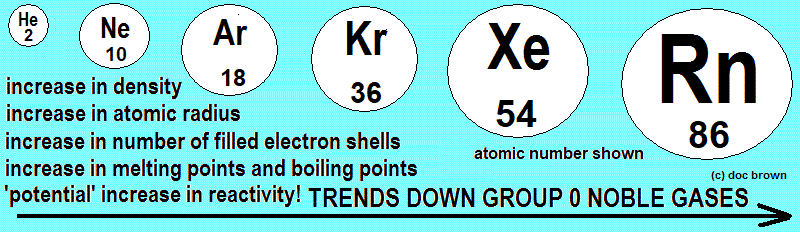
Proton number of group 0 noble gases All group 0 noble gases have eight electrons in the full outer shell, except helium just has the two, but still a full shell! The melting point of group 0 noble gases increases down the group The boiling point of group 0 noble gases increases down the group The density of group 0 noble gases increases down the group The atomic radii of group 0 noble gases increase down the group

Note: For atomic radii: 1nm = 10–9m,  1pm = 10–12m,  nm x 1000 = pm,  nm = pm/1000

Atomic radii always increase down a group with increase in atomic number because extra electron shells are successively added.

  • Important group 0 noble gas trends to know down the group  with increase in atomic number and relative atomic mass...

    • ... down the group the noble gas atoms get larger, the increase in radius is due to an extra shell of electrons added from one atom to the next down the group - the volume of the atom increases with more electrons in it.

    • ... the melting point and boiling point of noble gases steadily increase down the group (see data) because the weak intermolecular bonding forces increase with the size of the atom, from one noble gas down to the next, there is an extra shell of electrons.

      • This is because of the increase in the number of electrons, due to an extra electron shell from one noble gas, down the group to the noble gas on the next period.

      • This trend produces an increasingly larger atom with more, which results in an increase in the weak electrical attractive forces between the noble gas atoms (increasing intermolecular forces/intermolecular bonding).

        • Generally speaking, these weak attractive electrical forces, the intermolecular forces (NOT chemical bonds) increase with increasing numbers of electrons in the molecule.

        • Although noble gases exist as single atoms, the argument is the same for a series of hydrocarbon compounds like alkanes where the boiling points increase with increase in size of molecules.

      • So, because the strength of the intermolecular forces or intermolecular bonding forces between the atoms increases, so more energy (higher particle kinetic energy of vibration or free movement) at a higher temperature) is needed to melt or boil the condensed states of Noble Gas atoms and overcome these attractive forces.

      • Note this intermolecular force argument is the same for molecules of at least two atoms - think of the trend with hydrocarbon molecules like alkanes - its often just about the number of electrons in the 'particle'.

    • ... the density of noble gases steadily increases down the group (see data)

    • ... down the group, theoretically, the monatomic noble gases are more likely to react and form a compound with very reactive elements like fluorine, this is because the outer electrons are increasingly less strongly held giving a greater chance of electron sharing in forming a covalent bond with other very reactive non-metals like fluorine, chlorine and oxygen e.g.

      • Stable compounds of xenon, like xenon tetrafluoride, are now known and synthesised BUT not before 1961!

      • The most reactive Noble Gas would be radon BUT this is a highly dangerous radioactive gas!

      • Some VERY unstable compounds have been made from argon and krypton.

      • The reason for the lack of reactivity by noble gases is further explained in the box below.


TOP OF PAGE and sub-index for noble gases page

OR test yourself with a GCSE level m/c QUIZ on Noble Gases

or Structured exam practise questions on the Noble Gases

See also Advanced A-Level Chemistry Notes on the Group 0/18 Noble Gases

4. Electron structure and lack of reactivity in noble gases

Pd metals metals non-metal group
Gp1 Gp2 Gp3 Gp4 Gp5 Gp6 Gp7 Gp 0
1   2He

2

2 Li Be a short section of the periodic table with group 0 electron arrangements B C N O F 10Ne

2.8

3 Na Mg Al Si P S Cl 18Ar

2.8.8

4 K Ca Sc Ti V Cr Mn Fe Co Ni Cu Zn Ga Ge As Se Br 36Kr

2.8.18.8

The electron arrangement of the first 4 Noble Gases with very stable full outer shells (are shown) making the noble gas elements VERY unreactive.

Because the noble gas atoms have a full, and very stable, outer electron shell, they are very reluctant to share electrons to form a covalent bond OR lose or gain electrons to form an ion and ionic bond.

As the atom gets bigger, the outer electrons are less strongly held and the lower member noble gases e.g. xenon can be tempted into chemically reacting with VERY reactive chemical reagents like fluorine (the most reactive non-metal).

The electronic situation is quite different from:

(i) the Alkali Metals, whose atoms readily lose an electron to form a positive ion with a noble gas arrangement, in an ionic compound like sodium chloride, NaCl,

(ii) the Halogens, non-metal atoms, which readily gain an electron from a metal atom to form a negative ion with a noble gas arrangement, as in sodium chloride, AND, they also readily share an electron to form a covalent bond with other non-metals like hydrogen (HCl) or with themselves like the chlorine molecule, Cl2.

Noble Gases Noble Gases Noble Gases

TOP OF PAGE and sub-index for noble gases page

OR test yourself with a GCSE level m/c QUIZ on Noble Gases

or Structured exam practise questions on the Noble Gases

See also Advanced A-Level Chemistry Notes on the Group 0/18 Noble Gases

5. Uses of the Group 0/8 Noble Gases

The noble gases are non-flammable and chemically very unreactive and this chemical inertness is an important characteristic when understanding the uses and applications of noble gases and sometimes the low density is important too.

Uses of He helium The noble gas helium gas is much less dense than air (lighter) and is used in party balloons and 'airships' because it 'floats' in air! Thanks Niamh, (aged 31/2 at the time), for putting up with Granddad's camera work!

Another advantage is that because of its inertness, helium doesn't burn in air UNLIKE hydrogen which used to be used in large balloons with  'flammable' consequences e.g. like the R101 airship disaster!

Helium is also used in gas mixtures for deep-sea divers respiration.

Liquid helium is used to achieve very low temperatures in cryogenics technology.

Helium is used to protect metals that are being welded. The inert atmosphere stops the hot metal being oxidised giving a brittle coating of the metal oxide.

Uses of Ne neon Noble Gasesjust like this website! The noble gas neon gives out 'white light' when high voltage electricity is passed through it, so neon is used in glowing 'neon' advertising signs and fluorescent lights.
Uses of Ar argon Noble GasesNoble Gases The noble gas argon, like all the Noble Gases is chemically inert. It is used in filament bulbs because the metal filament will not burn (oxidise) in argon and it also reduces evaporation of the metal filament.

Argon is also used to produce an inert atmosphere in high temperature metallurgical processes, e.g. in welding where it reduces brittle oxide formation reducing the weld quality.

Argon bubbles are used to stir mixtures in steel production.

Argon is used in photographic flash lamps to stop the filament burning up in the high temperature flash.

Argon is the cheapest noble gas to produce, it has the biggest % of any noble gas in air.

Uses of Kr krypton   The noble gas krypton is not used by superman! BUT krypton is used in fluorescent bulbs, flash bulbs and laser beams.

Krypton stops the filament burning up in the high temperature flash lamps.

Uses of Xe xenon   The noble gas xenon is good for winning scrabble games! AND xenon also used in fluorescent bulbs, flash bulbs and lasers!

Xenon stops the filament burning up in the high temperature flash lamps.

Rn radon Noble Gases The noble gas radon almost no uses, but does have dangers! Radio-isotopes of radon are produced by radioactive decay of heavy metals (e.g. uranium) in the ground. Radon can build up in cellars, especially in granite areas (where cellars should be well ventilated to avoid dangerous concentrations building up) because it is a decay product of unstable uranium isotopes in the granite rocks. Like all radioisotopes, isotopes of radon can cause cell damage (DNA) and ultimately cancer (see link below) if breathed in. However it is used in some forms of cancer treatment, though it always seems ironic that radioisotopes that cause cancer can also be used to kill cancer cells..

Revision notes on the physical and chemical properties of the non-metal group 0 noble gases inert gases, explaining lack of chemical reactivity of noble gases, boiling/melting point trends of noble gases, uses of noble gases, help when revising for AQA GCSE chemistry, Edexcel GCSE chemistry, OCR GCSE gateway science chemistry, OCR GCSE 21st century science chemistry GCSE 9-1 chemistry examination questions on inert gases.

TOP OF PAGE and sub-index for noble gases page

OR test yourself with a GCSE level m/c QUIZ on Noble Gases

or Structured exam practise questions on the Noble Gases

See also Advanced A-Level Chemistry Notes on the Group 0/18 Noble Gases

6. Extra 'bits and bobs' on the Noble Gases

% noble gas in air by volume 0.0005% He, 0.0018% Ne, 0.93% Ar, 0.0001% Kr, 0.00001% Xe, ?% Rn - impossible to be zero, but an extremely minute trace hopefully! (varies with local geology)
Radon dangers Rocks, e.g. granite, can contain uranium metal compounds which are radioactive. When they 'decay' radioactively, radioactive and harmful radon gas can be formed.
Compounds of Noble Gases - yes they do exist! From the early 1960's compounds have been made, but only xenon compounds are stable and usually combined with oxygen and fluorine, which, not surprisingly, are the more reactive non-metals e.g.

Xe + 2F2 ==> XeF4

Using Ni catalyst 60oC, easy if you know how! and another catalytic example of a transition metal.


test yourself with a GCSE level m/c QUIZ on Noble Gases

and/or Q/A exercise below

7. GCSE level m/c QUIZ on Noble Gases

8. Multi-word fill worksheet on the Noble Gases


9. QUESTIONS

GCSE level chemistry - practise exam questions on the Group 0 Noble Gases - helium, neon, argon, krypton, xenon, radon

Jot down your responses and check out the answers:  ANSWERS

If you think there are any errors, please email me asap at chem55555@hotmail.com

I don't mind if students/teachers do a selected printout of these questions and answers.

You can use a periodic table to help you answer the questions


Q1 Why were helium, neon, argon and xenon called the Noble Gases?


Q2 In what form do the atoms of Noble Gases exist - suggest a reason.


Q3 Explain why the noble gas atoms get bigger down the group.


Q4 Explain why the melting and boiling points of noble gas atoms increase down the group


 Q5 Explain why Noble Gases are so reluctant to react form compounds.


 Q5 Explain the uses of the Noble Gases.

(a) Why is helium used in balloon?

(b) Why is neon used in lighting devices?

(c) Why is argon used in light bulbs and in metal welding procedures.

(d) Why does radon have no practical use?


Q5 At high temperatures and pressures, xenon combines with highly reactive fluorine to form xenon hexafluoride. Write an equation to represent the reaction.


Jot down your responses and check out the answers:  ANSWERS

If you think there are any errors, please email me asap at chem55555@hotmail.com

I don't mind if students/teachers do a selected printout of these questions and answers.

TOP OF PAGE and sub-index for noble gases page

OR test yourself with a GCSE level m/c QUIZ on Noble Gases

or Structured exam practise questions on the Noble Gases

See also Advanced A-Level Chemistry Notes on the Group 0/18 Noble Gases


10. KEY REVISION POINTS (doc b - AI collaboration, UK exam board survey)

Across the main UK GCSE exam boards (AQA, Edexcel, OCR, WJEC/Eduqas and CCEA), the required knowledge on Group 0 (the noble gases) is very similar

What GCSE students need to know about Group 0

1. The noble gases are in Group 0

The noble gases are:

  • Helium (He)
  • Neon (Ne)
  • Argon (Ar)
  • Krypton (Kr)
  • Xenon (Xe)
  • Radon (Rn)

They are found in the far-right column of the Periodic Table.

2. Their general properties

Students should know that noble gases are:

  • Non-metals
  • Colourless gases
  • Non-flammable
  • Monatomic (exist as single atoms, not molecules)
  • Very unreactive (inert)

3. Why they are unreactive

This is the most important examination point.

Noble gases have a full outer electron shell:

Element Electron arrangement
He 2
Ne 2,8
Ar 2,8,8

Because their outer shell is already complete, they do not need to gain, lose or share electrons, so they are very unreactive.

4. Trend in boiling point down the group

Students should know:

Boiling point increases down Group 0.

Reason:

  • Atoms get larger down the group.
  • Intermolecular forces become stronger.
  • More energy is needed to separate the atoms.

Therefore boiling points increase.

The same trend and argument applies to their melting points.

5. Uses of noble gases

Specifications commonly use noble gases to illustrate how their lack of reactivity makes them useful. Examples include:

Noble gas Use Why?
Helium Balloons Less dense than air and non-flammable
Neon Advertising signs Glows when electricity passes through it
Argon Light bulbs Unreactive, prevents filament burning
Argon Welding Provides an inert atmosphere

Advanced A-Level Chemistry Notes on the Group 0/18 Noble Gases

BUT reading this page reminds you of what you theoretically leaned from GCSE/IGCSE/O Level courses on noble gases!

So this page can act as a primer for the study of noble gases helium, neon, argon, krypton, xenon

Website content © Dr Phil Brown 2000+. All copyrights reserved on Doc Brown's Chemistry revision notes, images, quizzes, worksheets etc. Copying of website material is NOT permitted. Exam revision summaries & references to science course specifications are unofficial.  Doc Brown's Chemistry KS4 science GCSE and US grade 8-10 level Chemistry Revision Notes for help when revising for AQA GCSE chemistry, Edexcel GCSE chemistry, OCR GCSE gateway science chemistry, OCR GCSE 21st century science chemistry GCSE 9-1 chemistry examinations for questions on the Group 0 Noble Gases

Doc Brown's chemistry revision notes: basic school chemistry science GCSE chemistry, IGCSE  chemistry, O level & ~US grades 8, 9 and 10 school science courses or equivalent for ~14-16 year old science students for national examinations in chemistry, Revision notes on the physical and chemical properties of the non-metal group 0 noble gases inert gases, explaining lack of chemical reactivity of noble gases, boiling/melting point trends of noble gases, uses of noble gases, help when revising for AQA GCSE chemistry, Edexcel GCSE chemistry, OCR GCSE gateway science chemistry, OCR GCSE 21st century science chemistry GCSE 9-1 chemistry examination questions on inert gases. Explaining importance of group 0 noble gases in GCSE level chemistry, What you need to know about group 0 noble gases for GCSE level chemistry, Explaining use of group 0 noble gases knowledge in GCSE level chemistry, Examples of group 0 noble gases explained when studying GCSE level chemistry, What is the significance of group 0 noble gases in GCSE level chemistry, describing explaining theory of group 0 noble gases when studying GCSE level chemistry, exam revision notes for group 0 noble gases, online help for understanding group 0 noble gases in GCSE chemistry, what do I need to learn about group 0 noble gases? what do I need to know about group 0 noble gases for GCSE chemistry exams, how to prepare for questions on group 0 noble gases in GCSE chemistry examination? group 0 noble gases for syllabus-specifications for students taking the IGCSE/GCSE level chemistry examinations, summary revision notes key points on group 0 noble gases for students studying AQA igcse/gcse chemistry notes on group 0 noble gases, Edexcel gcse chemistry notes on group 0 noble gases,  OCR 21st century GCSE chemistry notes on group 0 noble gases, OCR gateway GCSE chemistry notes on group 0 noble gases, WJEC gcse chemistry notes on group 0 noble gases, CCEA gcse chemistry notes on group 0 noble gases, CIE Cambridge igcse chemistry, notes on group 0 noble gases useful for US grade 9-10 chemistry student courses


ANSWERS

GCSE level chemistry - practise exam questions on the Group 0 Noble Gases - helium, neon, argon, krypton, xenon, radon, oganesson

If you think there are any errors, please email me asap at chem55555@hotmail.com

I don't mind if students/teachers do a selected printout of these questions and answers.


Q1 Why were helium, neon, argon and xenon called the Noble Gases?

ANSWER

Because there were so unreactive

(Gold was called a noble metal for the same reason!)


Q2 In what form do the atoms of Noble Gases exist - suggest a reason.

ANSWER

They are all gases and exist as single atoms because they do not readily form bonds.

(Noble gases are sometimes referred to as 'monatomic molecules')


Q3 Explain why the noble gas atoms get bigger down the group.

ANSWER

The radius increase down the group as an extra shell of electrons is added from each atom to the next down the group - its simple an increase volume with the extra electrons.


Q4 Explain why the melting and boiling points of noble gas atoms increase down the group

ANSWER

Down the group the atoms increases in size with an extra shell of electrons. The greater the number of electrons the greater the intermolecular bonding forces. Therefore, down the group, the noble gas particles must have increasingly greater kinetic energies to overcome the attractive intermolecular forces to melt or boil.


 Q5 Explain why Noble Gases are so reluctant to react form compounds.

ANSWER

All noble gases have a full outer shell of electrons which is a particularly stable electron arrangement (He full outer shell of 2, rest have full outer shell of 8 electrons). Therefore, they do readily share, gain or lose electrons to form a chemical bond in a reaction, hence no compound is readily formed.


 Q5 Explain the uses of the Noble Gases.

(a) Why is helium used in balloon?

(b) Why is neon used in lighting devices?

(c) Why is argon used in light bulbs and in metal welding procedures.

(d) Why does radon have no practical use?

ANSWER

(a) Helium is much less dense than air, so the balloons float upwards due to the buoyancy effect.

(b) When a high voltage is applied to neon gas (at low pressure and via electrodes) it emits bright white light.

(c) These two explanations overlap. Argon atmosphere is inert and does not react with metals and prevents oxidation of metals. In a filament bulb the metal is unaffected and the argon reduces evaporation of the metal, so the bulb has a longer useful life. In welding, the argon atmosphere prevents oxidation of the metals being welded together. Any oxidation of the metal surfaces reduces the quality of the welded joint.

(d) Radon is too radioactive to be safely used for anything.


Q5 At high temperatures and pressures, xenon combines with highly reactive fluorine to form xenon hexafluoride. Write an equation to represent the reaction.

ANSWER

Xe  +  3F2  ===>  XeF6


If you think there are any errors, please email me asap at chem55555@hotmail.com

I don't mind if students/teachers do a selected printout of these questions and answers.


TOP OF PAGE and sub-index for noble gases page

OR test yourself with a GCSE level m/c QUIZ on Noble Gases

or Structured exam practise questions on the Noble Gases

See also Advanced A-Level Chemistry Notes on the Group 0/18 Noble Gases

TOP OF PAGE and sub-index for noble gases page