HOME PAGE * SEARCH * UK KS3 level Science Quizzes for students aged ~13-14
UK GCSE level Biology * Chemistry * Physics age ~14-16 * Advanced Level Chemistry age ~16-19
|
STATES OF MATTER - properties of gases and liquids (fluids) and solids 15. A kinetic particle model for dissolving a solid (the solute) in a solvent to give a solution i.e. describing & explaining what is a solution & how it is formed [Author © Dr Phil Brown GRIC, PhD: Doc Brown's chemistry exam revision notes on states of matter - physical properties of gases, liquids and solids, suitable for students of UK GCSE level and international IGCSE/O level chemistry courses, ~US grades 9-10 chemistry notes [page updated RE-EDIT]EMAIL query ? comment * [privacy, cookies and disclaimer] INDEX of all my notes on the states of matter GCSE (~US grades 8-10) level multiple choice QUIZ on the states of matter: gases, liquids & solids . Dissolving solids and solution formation
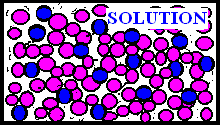
When a solid (the solute) dissolves in a liquid (the solvent) the resulting mixture is called a solution.
So, the solute is what dissolves in a solvent, a solvent is a liquid that dissolves things and the solution is the result of dissolving something in a solvent. The solid loses all its regular structure and the individual solid particles (molecules or ions) are now completely free from each other and randomly mix with the original liquid particles, and all particles can move around at random. This describes salt dissolving in water, sugar dissolving in tea or wax dissolving in a hydrocarbon solvent like white spirit. It does not usually involve a chemical reaction, so it is generally an example of a physical change. Whatever the changes in volume of the solid + liquid, compared to the final solution, the Law of Conservation of Mass still applies, no loss or gain of the total mass of the system. This means: mass of solid solute + mass of liquid solvent = mass of solution after mixing and dissolving. You cannot create mass or lose mass, but just change the mass of the substances into another form. If the solvent is evaporated, then the solid is reformed e.g. if a salt solution is left out for a long time or gently heated to speed things up, eventually salt crystals form, the process is called crystallisation.
Key points about the Kinetic Particle Model & DissolvingCore Explanation
Examples of solutions
Typical Exam Board-Specific Requirements
Student Exam Tips about dissolving and solutions
Typical Misconceptions about dissolving
Quick Revision Overlay about solution formation
Learning objectives for a particle models of solution formation
All my UK GCSE level (~US grade 8-10) school chemistry revision notes All my UK advanced level (~US grades 11-12) pre-university chemistry revision notes This is a BIG website, you need to take time to explore it [ SEARCH BOX]Email doc brown - comment? query?
Explaining importance of kinetic particle
model to explain dissolving
in GCSE level chemistry, What you need to know about kinetic particle
model to explain dissolving for
GCSE level
chemistry,
Explaining use of kinetic particle model to explain dissolving knowledge in GCSE level chemistry, Examples of
kinetic particle model to explain dissolving
explained when studying GCSE level chemistry, What is the significance
of kinetic particle model to explain dissolving in GCSE level chemistry, describing
explaining theory of kinetic particle model to explain dissolving when studying GCSE level chemistry, exam revision
notes for kinetic particle model to explain dissolving, online help for understanding
kinetic particle model to explain dissolving in GCSE
chemistry, what do I need to learn about kinetic particle model to
explain dissolving? what do I need to know
about kinetic particle model to explain dissolving for GCSE chemistry exams, how to prepare for questions on
kinetic particle model to explain dissolving in GCSE
chemistry examination? kinetic particle model to explain dissolving for
syllabus-specifications
for students taking the IGCSE/GCSE level chemistry examinations, summary
revision notes key points on kinetic particle model to explain
dissolving for students studying AQA
igcse/gcse chemistry notes on kinetic particle model to explain dissolving, Edexcel gcse
chemistry notes on kinetic particle model to explain dissolving, OCR 21st century GCSE
chemistry notes on kinetic particle model to explain dissolving, OCR gateway
GCSE chemistry notes on kinetic particle model to explain dissolving, WJEC gcse chemistry notes on
kinetic particle model to explain dissolving, CCEA
gcse chemistry notes on kinetic particle model to explain dissolving, CIE Cambridge igcse
chemistry, notes on
kinetic particle model to explain dissolving useful for US grade 9-10 chemistry student courses
|




 ENTER
chemistry words e.g. topic, module, exam board,
formula, compound, reaction, structure, concept, equation, any 'phrase',
homework question! anything of chemical interest, like your latest homework question!
or anything
of scientific interest! This is a very comprehensive Google
generated search of my website. |